OPC UA Client and Server
Using the FlowFuse Certified Node for OPC UA, connect to any OPC UA server as a client, or host your own server on self-hosted FlowFuse. Bridge structured, secured industrial data to Modbus, EtherNet/IP, MQTT, historians, and the cloud, all in the same flow.

What is OPC UA?
OPC UA stands for OPC Unified Architecture. OPC started life in 1996 as "OLE for Process Control," and later became "Open Platform Communications" once it moved beyond Microsoft's original OLE technology.
It isn't hardware, and it isn't a controller. It's a platform-independent, service-oriented specification for how data gets modeled, secured, and exchanged between an OPC UA server (the source exposing data) and an OPC UA client (the application consuming it).
Where a protocol like Modbus moves raw register values, OPC UA exposes a structured information model: an address space of typed objects and relationships, plus built-in services for subscriptions, historical access, alarms and events, and method calls.
Many PLCs expose an OPC UA server alongside their native protocol. If you're integrating directly with PLC hardware across multiple protocols, the FlowFuse PLC integration covers that. This page is about OPC UA itself: building clients and servers, securing them properly, and getting structured data where it needs to go.
OPC UA core services
- Address Space: structured, browsable information model
- Subscriptions: real-time, change-based updates
- Historical Access (HA): native access to logged history
- Alarms & Events (A&E): condition-based notifications
- Method Calls: invoke server-side logic remotely
- Security: certificates, authentication, SignAndEncrypt
Where OPC UA shows up
- Native servers on Siemens S7-1500, Omron, Beckhoff
- Rockwell/Allen-Bradley, via FactoryTalk Linx Gateway or a third-party server
- SCADA and historian data exchange
- Kepware and other OPC UA gateway products
- MES and enterprise system integration
- Unified Namespace, as the source of structured data
OPC UA's power gets left on the table.
Building an OPC UA client or server from scratch means wrestling with an SDK. Most teams route around that by paying per-tag for a gateway product instead. Either way, security ends up as whatever the vendor tool defaults to, not a deliberate choice. FlowFuse gives you a low-code runtime that does both client and server properly, with security you actually configure.
Backed by a FlowFuse Certified Node
FlowFuse connects to OPC UA through a FlowFuse Certified Node, vetted against three standing pillars: quality, security, and support. Quality means tested, reliable, and compatible. Security means proactive vulnerability handling, with certification revoked and customers notified if it falls short. All three get maintained on an ongoing basis.
The OPC UA certified node builds on node-opcua, the open-source OPC UA stack used across the industry. Sterfive develops and maintains it, the same team behind node-opcua itself, rather than a generalist contractor bolting on protocol support. The people maintaining your OPC UA connection are the people who maintain the stack it runs on.
One node handles both directions: connect to third-party OPC UA servers as a client, or host your own server on self-hosted FlowFuse. Both sides share a single certificate store, so a trust decision made for one applies to the other. Server hosting isn't available on FlowFuse Cloud. The node ships through the FlowFuse Edge Certified Nodes catalogue, contact us to enable it for your instance.
Core OPC UA capabilities in FlowFuse
FlowFuse supports OPC UA through dedicated client and server nodes, making it easy to connect OPC UA systems to your industrial applications.
Structured Information Model
Browse a real address space of objects, types, and relationships instead of a flat register list. Data arrives with context, not just a tag name and a number.
Browse & explore the address space →Real-Time Subscriptions
Subscribe to nodes and get notified only when values change. No polling every tag on a fixed interval, no wasted controller scan budget.
Monitor node reference →Historical Access & Logging
Read a server's native History (HA) service, or log live values into InfluxDB or TimescaleDB. Trends stay queryable long after the PLC buffer rolls over.
History Read node reference →Alarms & Events
Subscribe to condition-based alarms natively, filtered by type and severity on the server side. Stop polling fault bits and reconstructing state changes after the fact.
Monitor Event node reference →Security Built Into the Spec
X.509 certificate authentication, user authentication, and SignAndEncrypt come with the standard. Reverse Connect covers servers that can't accept inbound sessions.
Configure a secure connection →Client + Server, One Runtime
Read and write a third-party server as a client. On self-hosted FlowFuse, expose your own curated information model as a server, in the same flow.
Hosting an OPC UA server →OPC UA is one protocol. FlowFuse bridges all of them.
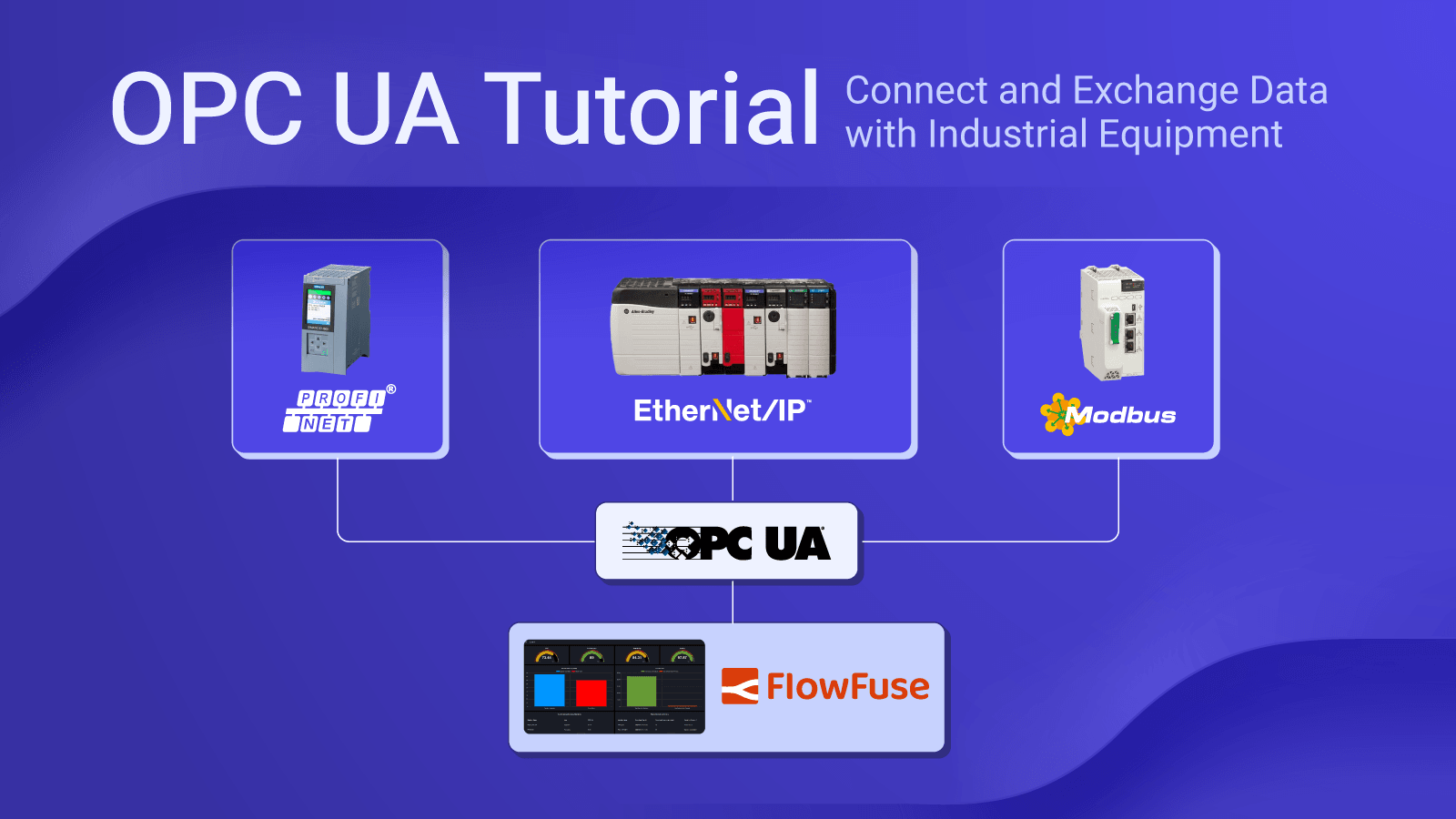
Real plants are never one protocol. OPC UA on the new line, Modbus on the legacy skid, EtherNet/IP on the Allen-Bradley cell, a camera feed nobody's touched since commissioning. FlowFuse runs them all in the same flow, so bridging data between them is a wire between nodes rather than a separate integration project.
Modbus
TCP, UDP, and Serial (RTU/ASCII) in one long-term supported package. Read and write coils and registers, or simulate a server for testing.
Modbus Certified Node →EtherNet/IP (CIP)
Native Rockwell and Allen-Bradley connectivity: ControlLogix, CompactLogix, Micro800, SLC500, and other CIP-capable devices.
CIP Suite Certified Node →RTSP Video
Turn factory-floor camera feeds into images your flow can act on, alongside the sensor and PLC data flowing beside it.
RTSP Certified Node →Siemens S7
Direct S7comm connectivity to S7-300, S7-400, S7-1200, and S7-1500 PLCs, for the many Siemens deployments that predate an OPC UA server.
Siemens S7 integration guide →MQTT
Publish OPC UA, Modbus, or S7 data to any MQTT broker in the same flow, normalized into a Unified Namespace topic hierarchy.
Bridging OPC UA to MQTT →5,000+ Community Nodes
Beyond the certified set: PROFINET, BACnet, DNP3, IEC 61850, Mitsubishi MC Protocol, Omron FINS, Beckhoff TwinCAT ADS, and more.
Browse the node library →Modbus, EtherNet/IP, and RTSP ship as FlowFuse Certified Nodes through the FlowFuse Edge catalogue. Everything else is a free, open-source community node or built into core Node-RED.
Lock down OPC UA security, don't leave it optional
Most OPC UA breaches in the field don't come from broken cryptography. They come from security that was configured once during commissioning and never switched on. FlowFuse makes the secure path the easy path.
How attackers get in
Disabled trust lists, self-signed certificates that never rotate, and Security Policy left at None since commissioning. These are the openings threat actors actually use, not cryptographic flaws in the standard.
Read: how threat actors exploit OPC UA →A defensible architecture
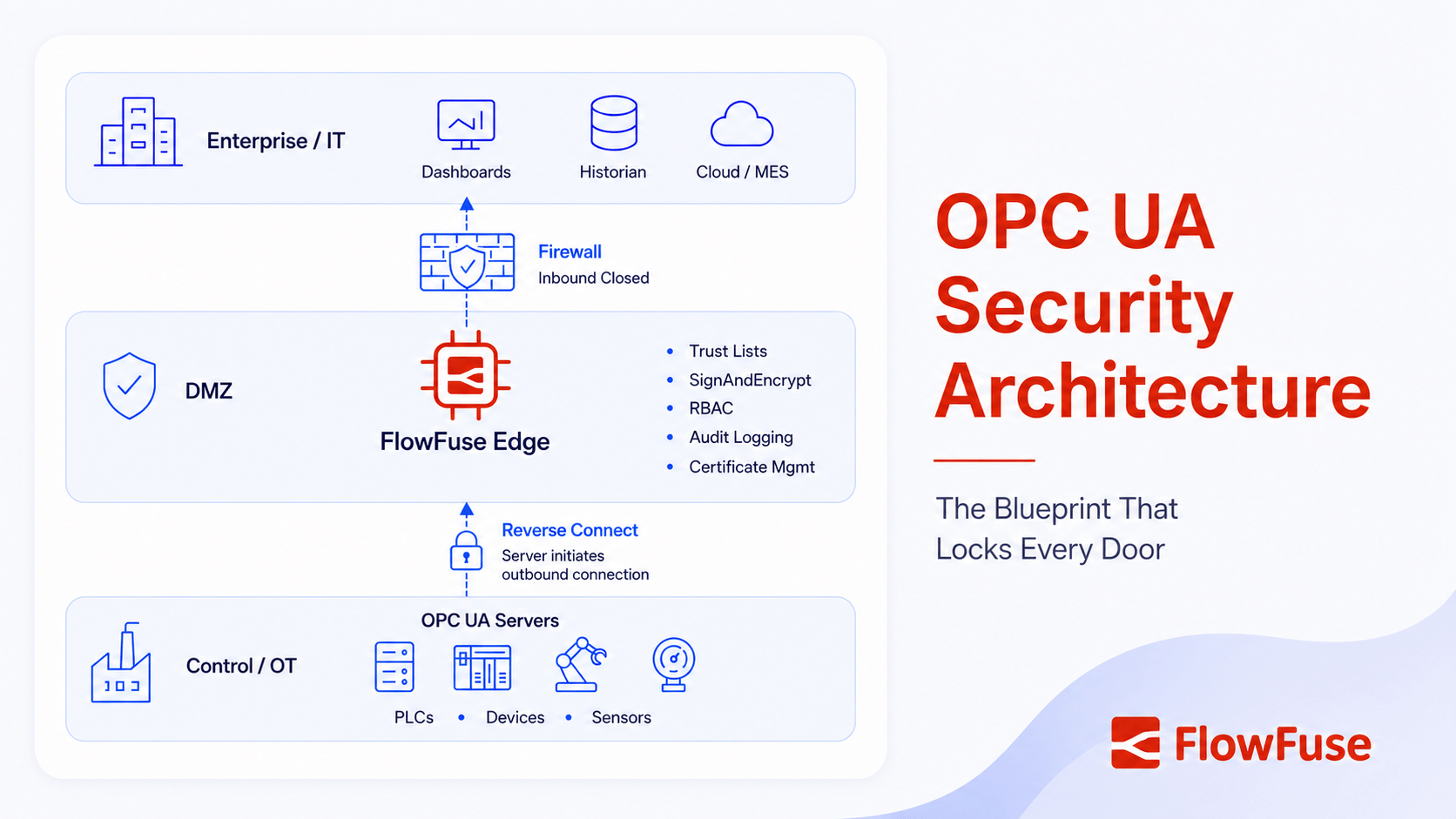
Reverse Connect for servers that can't accept inbound sessions, GDS-managed certificate lifecycles, SignAndEncrypt as the default, and role-based access. A checklist turned into working configuration.
Read: building a defensible OPC UA architecture →Built for Enterprise OPC UA Deployments
FlowFuse is SOC 2 Type I and Type II certified, with role-based access control, single sign-on, audit logging, and air-gapped, self-hosted deployment options, for teams running OPC UA clients and servers across regulated or security-sensitive plants.
Review our security and compliance detailsSOC 2 Type II
Single Sign-On
Audit Logs
Role-Based Access Control
Air-Gapped / Self-Hosted Deployment
How does OPC UA compare?
OPC UA gets compared to other protocols and products constantly, usually without enough nuance. Here's the honest version of each.
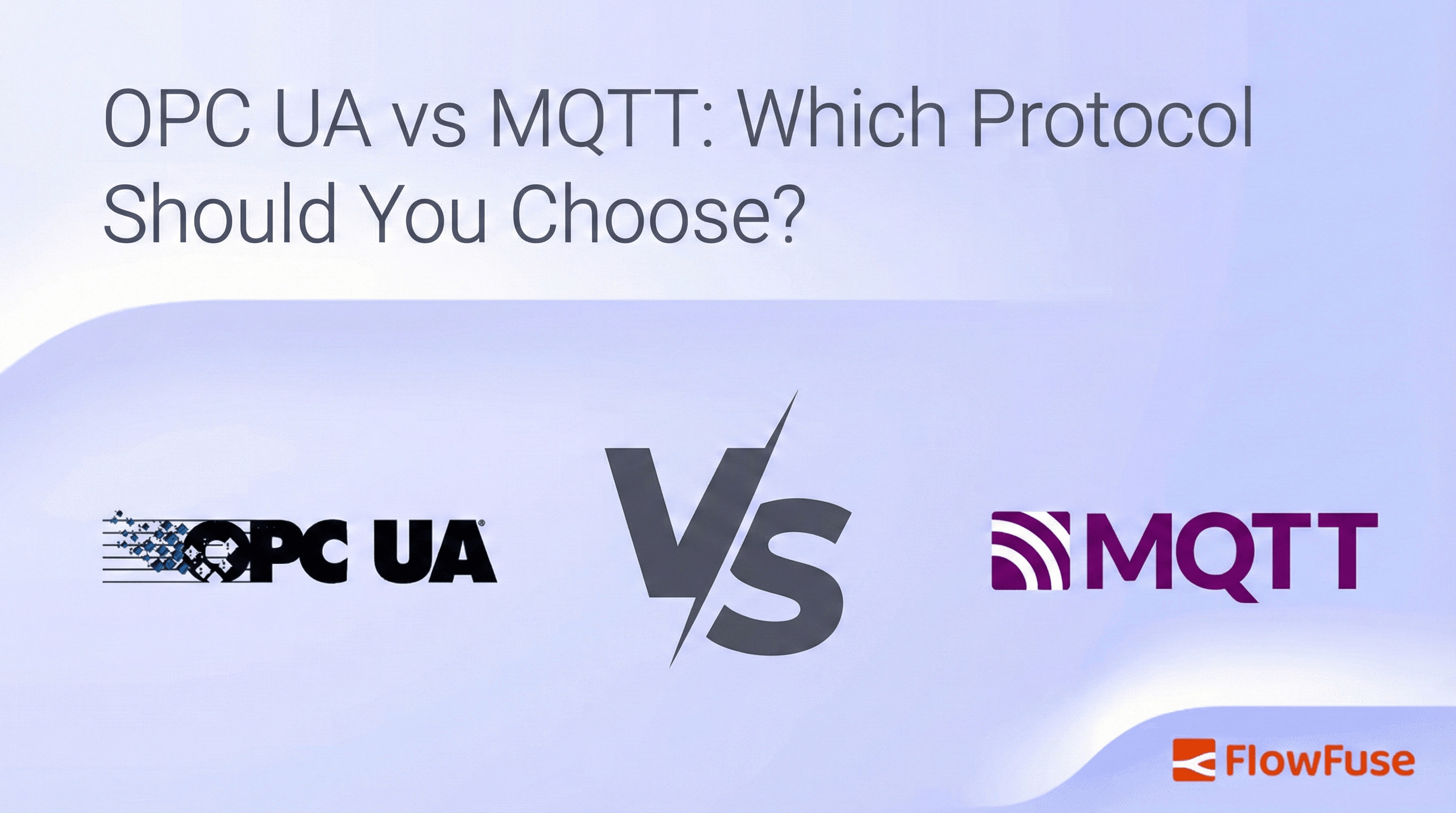
OPC UA vs MQTT
Different jobs, not rivals. OPC UA pulls structured data out of a single source. MQTT distributes it many-to-many across a Unified Namespace. Most plants run both.
Read the full comparison →OPC UA vs Modbus
OPC UA wins on security, data typing, and discoverability. Modbus still ships on new field devices because it's cheap, simple, and universal.
Why Modbus survives →OPC UA vs OPC DA
OPC DA is the Windows-only COM/DCOM original, with no built-in security and no information model. Most teams bridge DA into UA rather than choose between them.
Bridge a legacy OPC server →FlowFuse vs Kepware
Per-tag pricing scales badly, and ownership changes make long-term cost harder to predict. Connect to your existing Kepware server, or replace it outright.
Beyond Kepware →What you can build with OPC UA + FlowFuse
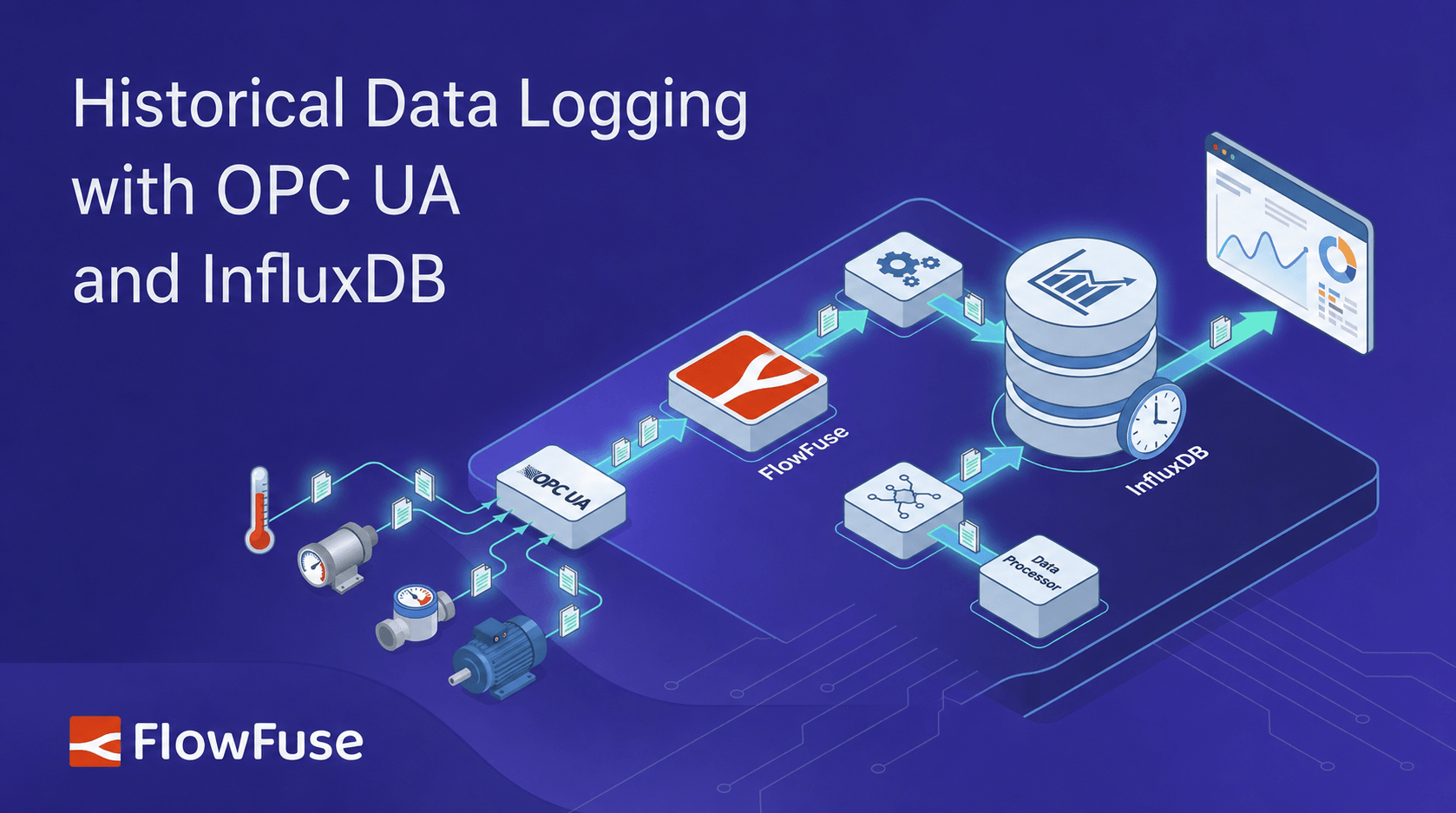
Historical Data Logging
Subscribe to OPC UA nodes and write timestamped values into InfluxDB or TimescaleDB, for a durable history that outlives the server's own buffer.
OPC UA to InfluxDB guide →OPC UA Client Dashboards
Browse an address space, read and write values, subscribe to alarms, then wire the results straight into a live operator dashboard. No separate client, no separate HMI license.
Build an OPC UA client dashboard →Bridging OPC UA to MQTT / UNS
Pull structured data out of an OPC UA server and republish it to any MQTT broker, normalized into a Unified Namespace topic hierarchy on the way.
Bridging OPC UA to MQTT →Agentic AI on OPC UA Data
Let an AI agent query the information model directly, correlating live values, alarms, and history to surface a root cause instead of a manual address-space search.
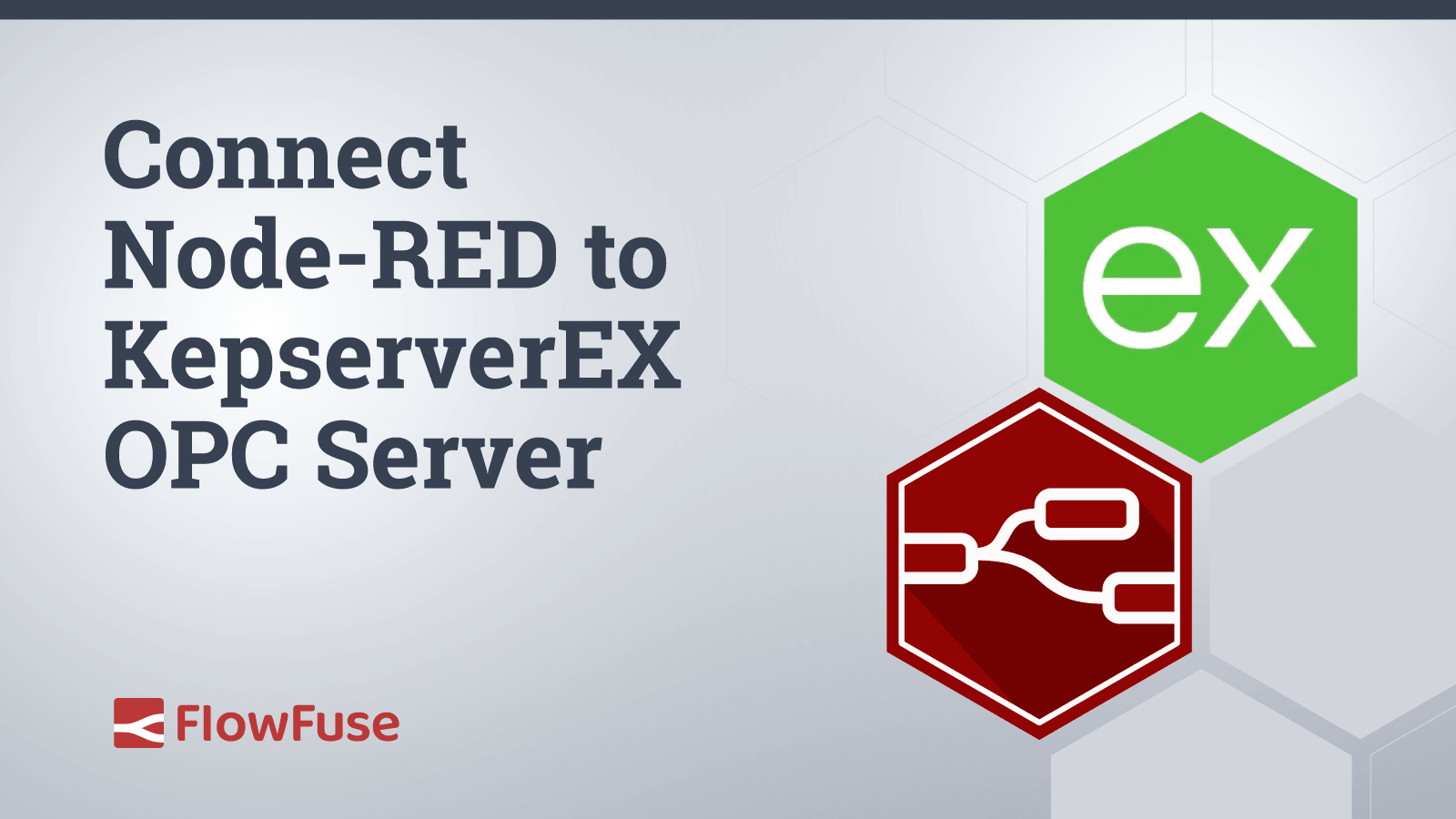
Agentic AI reads OPC UA servers →Migrating Off Kepware
Connect to an existing KepServerEX server as a client today, no rip-and-replace. Retire it on your own timeline by hosting an equivalent server on self-hosted FlowFuse.
Connect to a Kepware OPC server →Hosting Your Own OPC UA Server
Model your own address space and expose it as a standards-compliant server, so any SCADA, historian, or other client can browse and subscribe to it. Requires self-hosted FlowFuse: Cloud exposes HTTP/HTTPS only, and a server needs a raw TCP port.
Deploy a basic OPC UA server →From OPC UA to insight, step by step
-
Step 1
Connect or Build
Browse and connect to an existing OPC UA server as a client. On self-hosted FlowFuse, model your own address space and expose it as a server, from the same canvas.
-
Step 2
Secure the Session
Set Security Policy to SignAndEncrypt, configure certificate trust lists, and use Reverse Connect where the server can't accept inbound sessions.
-
Step 3
Bridge Other Protocols
Wire in Modbus, EtherNet/IP, or Siemens S7 nodes alongside OPC UA in the same flow, for the plants that aren't running OPC UA end to end.
-
Step 4
Visualize, Route & Scale
Wire the results into a live dashboard, forward data to MQTT, a time-series database, or a cloud platform. Then push the flow to one edge device or a thousand with one click.
Frequently asked questions
OPC UA guides and webinars
Start here
Secure it

Compare and migrate


Put the data to work
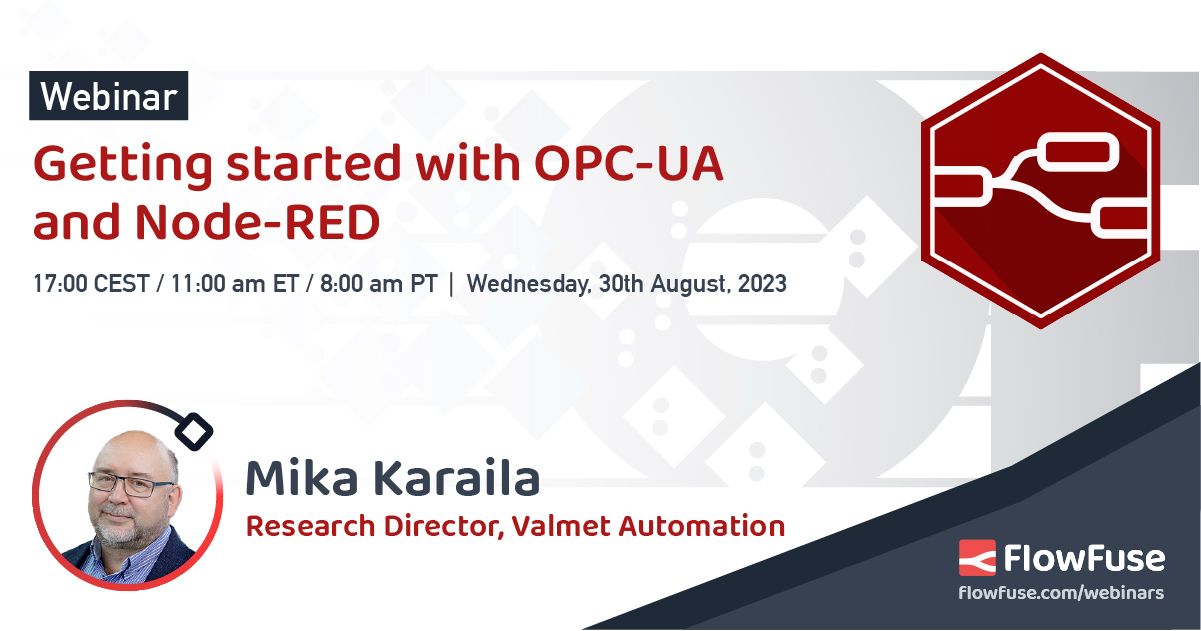
Webinars


Ready to build an OPC UA client or server the right way?
No per-tag licensing. No Security Policy left at None. Connect to any OPC UA server, host your own, and bridge both to Modbus, MQTT, or a historian in the same flow. See it live, or start free.